You don’t know him, but he knows you.
He knows what you eat for breakfast. He knows why you think a diamond ring means “forever.” And he didn’t just guess these things. He engineered them.
Edward Bernays (1891–1995) was an Austrian-American pioneer of public relations whose influence shaped advertising, politics, and media throughout the 20th century. If you’ve ever wondered why the world feels like a giant sales pitch… or why “the news” sometimes feels like an ad… you need to understand this man.
Because once you see his playbook, you can’t unsee it.
Who Was Edward Bernays?
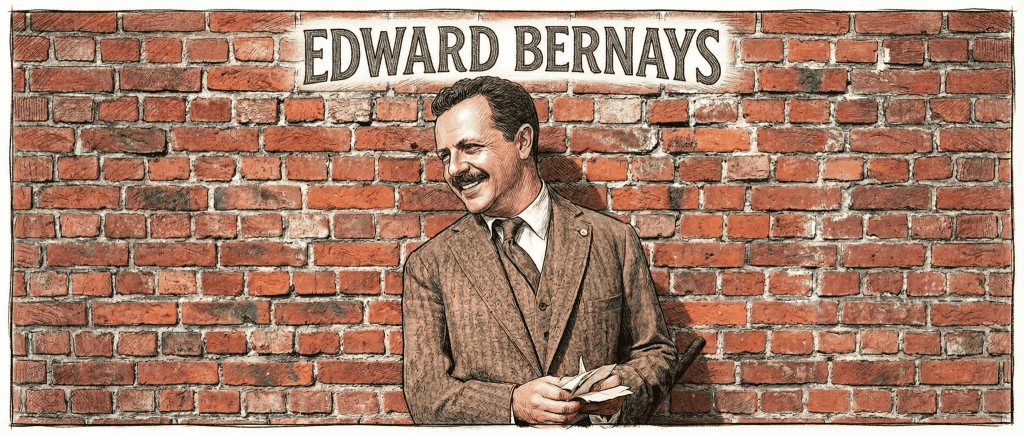
Edward Bernays wasn’t just a slick salesman. He was royalty in the world of psychology. (See his Wikipedia here)
His uncle was Sigmund Freud. Yes, that Freud.
While Uncle Sigmund was in Vienna analyzing dreams and the unconscious mind, Bernays was in New York wondering: “Can I use this to sell soap?”
Before Bernays, advertising was functional and blunt. “Buy this car because it has durable tires.” Bernays realized that was an absolute waste of time.
He understood that humans aren’t fundamentally rational. We are emotional, irrational creatures driven by hidden desires, social anxieties, and deep-seated insecurities.
Edward Bernays believed propaganda was not manipulation, but a necessary tool for organizing modern democratic society.
He believed that the masses couldn’t be trusted to make their own choices, and instead needed to be guided by what he termed an “invisible government” of intelligent men.
Over the last two decades, I’ve managed over $10 million on Facebook ads personally and generated $100 million for clients, plus sold two info-marketing businesses to a publicly traded company.
I can tell you plainly… Bernays wasn’t just right. He is the reason your ads work today.
Edward Bernays and Sigmund Freud: Hacking the Unconscious Mind
The connection between Edward Bernays and Sigmund Freud is the ultimate key to his entire career. Bernays was Freud’s “double nephew”… his mother was Freud’s sister, and his father was the brother of Freud’s wife.
Bernays was the first person to take Freud’s complex theories about hidden primal drives and intentionally weaponize them to sell physical products.
While Freud wanted to analyze and liberate the unconscious mind, Bernays wanted to hack it for commercial leverage.
He realized that if you connect a product to a person’s deeply rooted emotional desires or social fears, the sale becomes completely automatic.
You stop selling the features of the object, and you start selling the identity or the emotional relief the object represents.
Famous Campaigns: What Did Edward Bernays Do?
Bernays spent decades advising massive corporations, politicians, and global entities. He didn’t just write copy; he altered the baseline environment of everyday life. Here is exactly how he did it.
1. The Torches of Freedom: Edward Bernays’ Cigarette Campaign
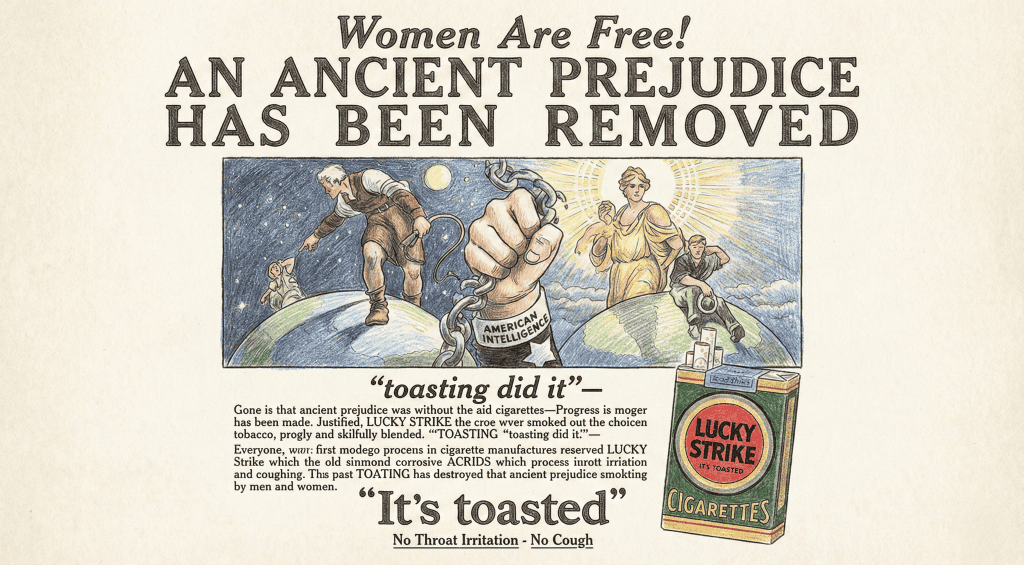
You’ve probably heard the cigarette story. It’s the greatest hit. But you rarely hear the sequel, which is even crazier.
The Taboo
It’s 1929. The American Tobacco Company has a problem. Men are smoking Lucky Strikes like chimneys, but women aren’t. It’s considered dirty. Unladylike. A seemingly unbreakable cultural rule.
George Washington Hill, the President of American Tobacco, tells Bernays:
“We’re losing half our market. Fix it.”
Bernays doesn’t run an ad saying “Ladies, please smoke.” Instead, he calls a psychoanalyst. He asks, “What does a cigarette mean to a woman?”
The answer: Power.
This is the move 99% of copywriters skip. Before you write a single word, understand your audience deeply enough to know what your product actually represents to them.
It’s a phallic symbol. It represents a challenge to male dominance.
So, Bernays orchestrates a fake protest. He hires debutantes (fashionable, wealthy young women) to march in the New York Easter Parade. At the perfect moment, the women stop. They reach into their garter belts. They pull out Lucky Strikes.
And they light up.
Bernays tells the press these aren’t cigarettes. They are “Torches of Freedom.”
The next day, it’s front-page news globally. “Women Strike Blow for Equality.” Suddenly, smoking wasn’t a dirty habit. It was a feminist statement. Sales exploded.
The Green Ball (The Deep Cut)
A few years later, Lucky Strike hits another wall. Women are smoking, but they aren’t buying Lucky Strikes.
Why? Because the pack was green. And in 1934, green clashed with every fashionable dress in a woman’s closet.
The CEO told Bernays: “Change the package colour.”
Bernays said: “No. That’s too expensive. I’ll change the culture instead.”
I’m serious. Bernays decided to make green the “Colour of the Year.”
- He organized a “Green Ball” at the Waldorf-Astoria for society’s elite.
- He convinced French fashion houses to release all-green fall collections.
- He got art galleries to host “Green Exhibitions.”
Six months later, green was the hottest colour in fashion. And suddenly, that green Lucky Strike pack wasn’t an eyesore. It was the perfect accessory.
If the product doesn’t fit the world, change the world.
2. Edward Bernays and the Bacon and Eggs Breakfast Myth
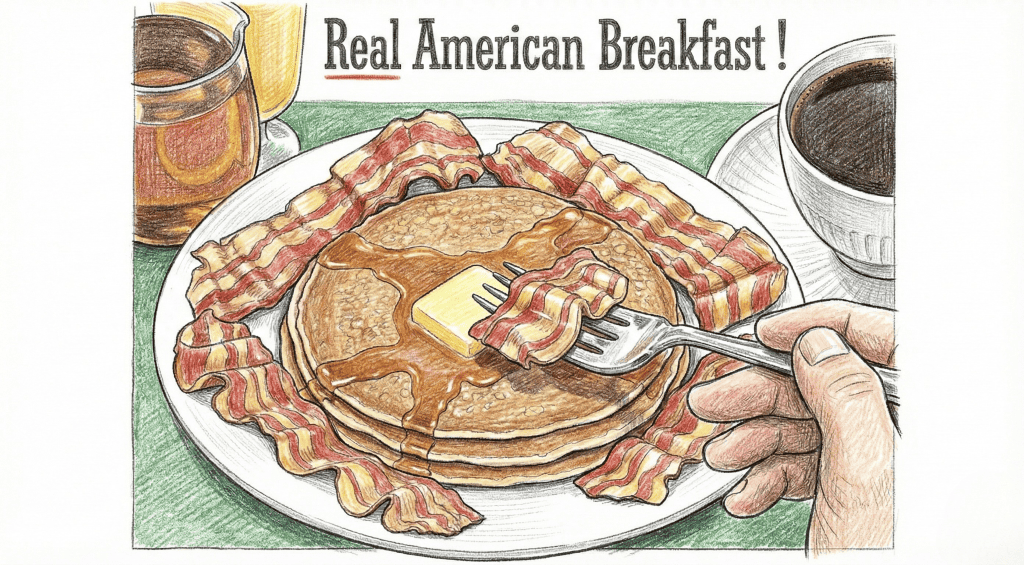
This is the one that gets me every time I look at a diner menu.
In the 1920s, the Beech-Nut Packing Company (who sold pork) was struggling. Americans ate light breakfasts. Toast, orange juice, coffee. Maybe a roll. Heavy meat was for dinner.
Bernays didn’t argue about the taste of bacon. He argued about health.
He went to a doctor and asked a loaded question:
“Would you say that a heavy breakfast is better for the American worker than a light breakfast, to replace the energy lost overnight?”
The doctor, thinking about calories, said “Yes.”
Bernays then asked that doctor to write to 5,000 other doctors asking the same question. Obviously, most of them agreed. A “heavy” breakfast provides more energy.
Bernays took that data and sent it to every newspaper in the country. The headline? “4,500 Physicians Urge Americans to Eat Heavy Breakfasts.”
And what did the article suggest as the perfect heavy breakfast? Bacon and Eggs.
Sales of bacon skyrocketed. Bernays didn’t sell pork. He sold “Doctor’s Orders.” He manufactured authority. To this day, 100 years later, we think bacon and eggs is the “traditional” American breakfast.
It’s not tradition. It’s a marketing campaign.
That’s the move when you’re building an irresistible offer… you don’t argue about your product. You change the context the buyer sees it in.
3. Edward Bernays and the Ivory Soap Sculpture Campaign
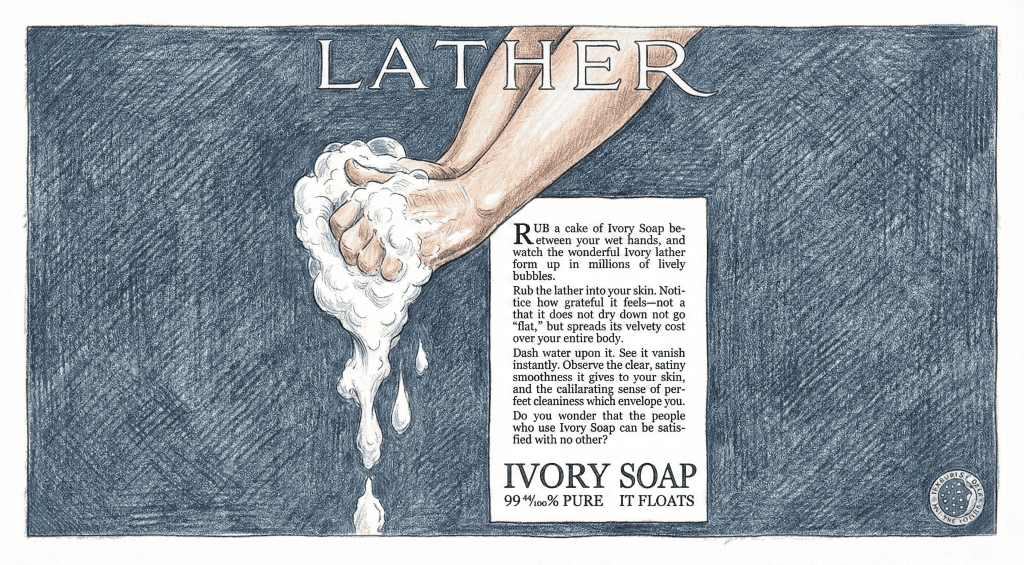
Most marketers stop at the parents. Bernays went for the children
Procter & Gamble had a problem with Ivory Soap. It was white, unscented, and boring. Women preferred the fancy, scented French soaps. And kids? Kids hated soap because it meant getting soap in their eyes during bath time.
Bernays needed to make kids love soap. So he created the National Soap Sculpture Competition.
He positioned soap carving as a legitimate art form. He got prestigious art galleries in Manhattan to host exhibitions of soap sculptures. He convinced school superintendents across America to include soap carving in the art curriculum.
Why? Because if a kid is carving a bar of Ivory Soap, he isn’t using it to wash. He’s destroying it. And then his mom has to buy another bar.
Within a year, millions of school children were carving Ivory Soap. That is millions of bars of soap, destroyed in the name of “art,” paid for by parents.
If you can’t increase consumption through use, increase consumption through waste (or in this case, “creativity”).
4. Edward Bernays and the Hairnet Scare: Fear-Based Marketing
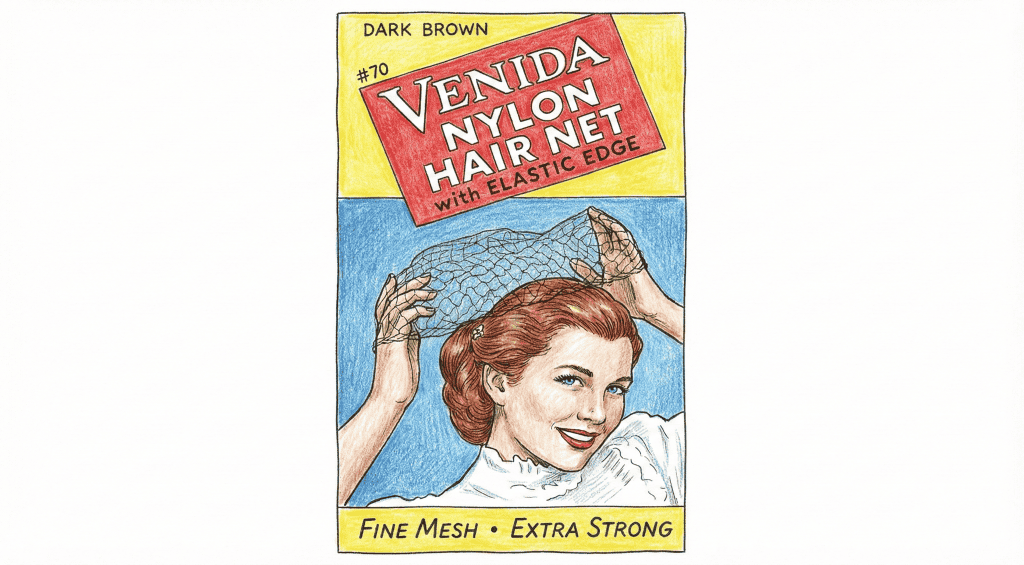
This is where the “Scheme” gets dark. And it’s important you see this side of him.
In the 1920s, the “Bob” haircut became famous. Short hair for women. This was a disaster for the Venida Hairnet Company. Women with short hair don’t need hairnets. The industry was collapsing.
Bernays didn’t try to make long hair cool again. He went to the government.
He started a PR campaign about the “dangers” of loose hair in factories and restaurants. He planted stories about women getting scalped by machinery because their hair wasn’t tied back. He planted stories about finding hair in food at restaurants.
He whipped up so much public anxiety that health departments and labor unions demanded strict enforcement of sanitary and safety codes requiring hairnets in the workplace.
He didn’t persuade the women to buy the product… he used institutional regulations to force them to buy it.
What Is “The Engineering of Consent”?
“The Engineering of Consent” is the central phrase Bernays coined to describe his entire system of persuasion. He treated the public mind like a civil engineering project. He argued that you can calculate, design, and build public support for an idea or a product with the exact same precision an engineer uses to construct a bridge.
Instead of guessing at slogans, you apply deep scientific research to uncover the target market’s existing psychological drivers. Once you understand those levers, you use media distribution, third-party authority, and staged events to guide the market to a predetermined conclusion. You make the consumer believe the purchase was entirely their own idea.
The Dark Side: The Goebbels Connection and Guatemala
It is critical to see the dark side of this lineage. Bernays’ techniques were so ruthlessly effective that they transcended standard commerce and entered global politics.
In his 1928 book Propaganda, Bernays wrote openly about the mechanics of mass manipulation. In the 1930s, Karl von Wiegand, a foreign correspondent for Hearst newspapers, informed Bernays that Joseph Goebbels… the chief propagandist for the Nazi regime… was actively using Bernays’ book Crystallizing Public Opinion as the blueprint for his campaigns. Bernays was deeply shocked by it, but it proved a terrifying reality: psychological systems are entirely indifferent to who wields them.
Decades later, Bernays put his skills to work in global geopolitics. Representing the United Fruit Company in the 1950s, he helped construct the massive, coordinated propaganda campaign that shifted American public opinion and helped manufacture the public support that preceded the CIA-backed coup to protect corporate banana plantations.
Why Edward Bernays Matters Today
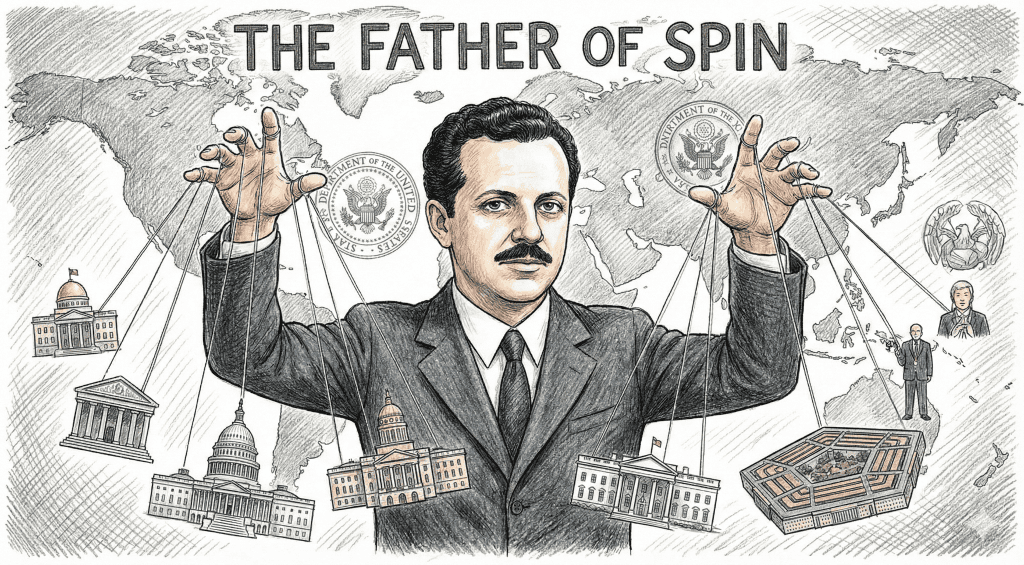
Edward Bernays spent over five decades advising global corporations and governments, turning his specialized knowledge into immense personal influence.
But his legacy holds a massive structural lesson for the modern digital operator.
Bernays didn’t just look at copywriting as words on a page.
He understood that to build a real asset, you have to transition from a simple technician to a strategic architect.
He didn’t pitch product features… he managed the entire environmental context.
Every principle of modern digital marketing has Bernays’ fingerprints on it.
He is the direct bridge between Freud’s couch and your Facebook ad. If you are building a business, a brand, or a movement today, you cannot ignore these three operational laws:
- Stop Selling the “Thing”: People don’t want products. They want to be part of something bigger than themselves. When an offer aligns perfectly with a prospect’s core identity, the transaction becomes entirely automatic.
- Manufacture Authority: Don’t just declare that you’re good. Find an objective authority, cite deep research, and publish it everywhere. Suddenly, it’s no longer just your marketing opinion… it’s established consumer science.
- Create the News: Never sit around waiting for attention or hoping traffic magically finds you. Stage the narrative context yourself. Bernays proved one liberating truth: reality is entirely negotiable.
But the real leverage comes when you stop using these deep psychological frameworks to build someone else’s corporate empire. If you are going to use direct response strategies to locate unserved demand, you must link that capability to an asset you completely own.
This is why I don’t believe in chasing massive, generic markets or trying to sell a bland commodity to everybody. You must aim your message strictly at the one specific buyer built to say yes.
If you are ready to stop guessing at avatars, stop wasting capital on cold traffic, and instead learn the modern direct response roadmap to create an irresistible offer that completely aligns with your market’s deepest needs, go grab a copy of Stop Selling to Everybody for $29 today. It is your definitive guide to claiming your sandbox, building your container, and owning your financial future.
Important Books by Edward Bernays
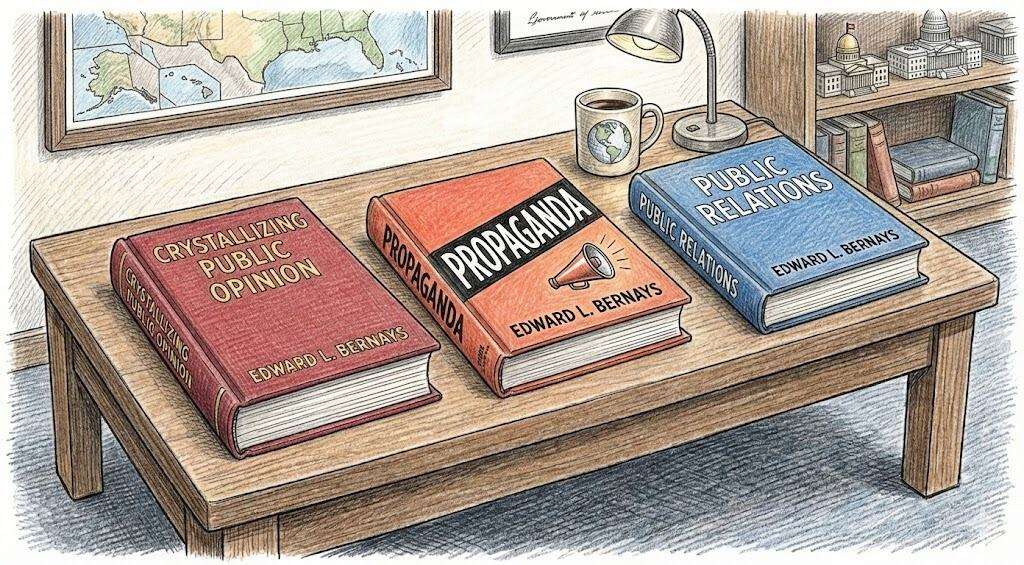
To understand the full depth of his philosophy, these are the essential texts:
- Crystallizing Public Opinion (1923)
This was the first book to ever define public relations as a science rather than a hustle. Bernays moves beyond simple press agentry and introduces the “PR counsel” as a bridge between the client and the public. It lays the groundwork for understanding that public opinion isn’t static… it’s something you can actively shape with data and psychology. - Propaganda (1928)
This is the manual. Bernays unapologetically argues that the “invisible government” which manipulates the habits and opinions of the masses is the true ruling power of society. He breaks down exactly how to regiment the public mind just like an army regiments bodies… making it the essential playbook for anyone studying modern influence. - The Engineering of Consent (1955)
If Propaganda is the philosophy, this is the blueprint for construction. Bernays treats persuasion like a civil engineering project… arguing that you can calculate and build public support with the same precision as building a bridge. It shifts focus from the “why” to the hard “how” of getting a “yes” at scale.
Frequently Asked Questions About Edward Bernays
Who is the father of public relations?
Edward Bernays is universally recognized as the “Father of Public Relations.” He took the old-school industry of “press agentry” and transformed it into a predictable, behavioral science by applying principles of clinical psychology to mass consumer commerce.
What is Edward Bernays best known for?
He is best known for creating iconic, high-converting propaganda campaigns that permanently shifted global culture. His most famous projects include making female smoking socially acceptable via the “Torches of Freedom” march, establishing bacon and eggs as the definitive American breakfast, and using public fear to mandate commercial hairnets.
Edward Bernays net worth: How much did he make?
While exact private estate numbers are not fully public, Bernays was one of the highest-paid corporate advisors of the 20th century, commanding massive multi-decade retainers from giants like Procter & Gamble, General Electric, and the American Tobacco Company, leaving behind a highly substantial financial fortune upon his death in 1995.
Was Edward Bernays related to Sigmund Freud?
Yes. Bernays was Sigmund Freud’s double nephew. His mother was Freud’s sister, and his father was the brother of Freud’s wife. This exact family lineage allowed Bernays to become the very first marketer to translate clinical psychoanalysis into commercial direct response copy.
What did Edward Bernays say about propaganda?
In his 1928 book Propaganda, Bernays wrote: “The conscious and intelligent manipulation of the organized habits and opinions of the masses is an important element in democratic society… Those who manipulate this unseen mechanism of society constitute an invisible government which is the true ruling power of our country.”
Who is called the “Father of Propaganda”?
Edward Bernays holds this title alongside his public relations designation. Because the word “propaganda” suffered a major public image problem after its heavy use in World War I, Bernays strategically rebranded the entire operational field to “Public Relations” to make it acceptable for commercial corporate use.
The evolution of direct response persuasion has deep, historical roots that connect the early mass-media campaigns of Bernays straight to the classic systems used by later legends like Claude Hopkins and Gary Halbert. If you want to see exactly how these generational marketing frameworks fit together to build scalable containers for wealth, check out my full diagnostic breakdown of direct response copywriting.