
“Properly exploited, one good idea that occurs to you while walking on a beach is worth more than 10 lifetimes of hard work.” – Gary Halbert
When Gary Halbert asked his seminar students that question, the answers came fast. Some said they wanted the highest quality beef. Others argued for the lowest prices. Some wanted a secret sauce, brilliant branding, or a beautiful location.
Halbert looked at them and shook his head.
“The only advantage I want,” he told the room, “is a starving crowd.”
That one sentence contains the entire hidden architecture of wealth. Halbert… affectionately known as the “Prince of Print”… understood a fundamental truth that most modern digital agencies and copywriters miss entirely:
You do not create demand. You find it.
I first stumbled across Halbert back in 2016 and immediately bought his books, including The Boron Letters and How to Make Maximum Money in Minimum Time. Later on, hearing his name echoed by legends in groups like Brian Kurtz’s Titans masterminds only solidified what I already knew: this guy was the real deal.
Reading his stuff showed me what is truly possible for a regular person. If you can understand what the market actually wants to buy, obsess over your craft, and show up consistently over a long period of time… you are going to get a win.
It is simply a matter of getting more at-bats and deeply understanding exactly who you are serving.
And of all the legendary insights Halbert put into the world.
Think about that. It completely flips the hustle-culture script. It means your breakthroughs don’t come from grinding your gears in an empty room… they come from finding that exact pocket of raw, starving demand.
Who Was Gary Halbert?
To understand Gary Halbert, you have to realize that he was completely unique. By unique, I mean he beat to his own drum. He wasn’t a corporate ad executive in a tailored suit sitting in a mahogany boardroom.
He was a wild, brilliant, larger-than-life character who lived on houseboats, made millions of dollars on a single campaign, and spent fortunes just as fast as he brought them in.
Gary is immortalized with his writing that still lives online today. (Check out his letters here.)
By his own cheerful admission, he was “the world’s greatest copywriter.” He was an absolute master of direct marketing, and for a very long time, he had the numbers to back it up.
His most famous success… the legendary “Coat of Arms” letter… is widely considered the most mailed sales letter in human history.
It was a simple, highly personalized one-page letter offering people a custom report on their family name’s heraldry and history. Halbert didn’t guess if people wanted it. He tapped into the deep, foundational human desires for identity, pride, and belonging.
That single piece of direct response copywriting was mailed by the hundreds of millions over a thirty-year run. At its peak, it required his team to set up a dedicated post office branch just to handle the incoming bags of checks and cash.
But Halbert’s life was a rollercoaster of extreme booms and busts. In the 1980s, following a series of legal issues tied to mail fraud, he spent time at Boron Federal Prison Camp.
He didn’t let a prison sentence stop him from writing. In fact, that prison camp became the birthplace of what many consider the greatest educational resource in copywriting history.
The Boron Letters: Masterclass From a Federal Prison
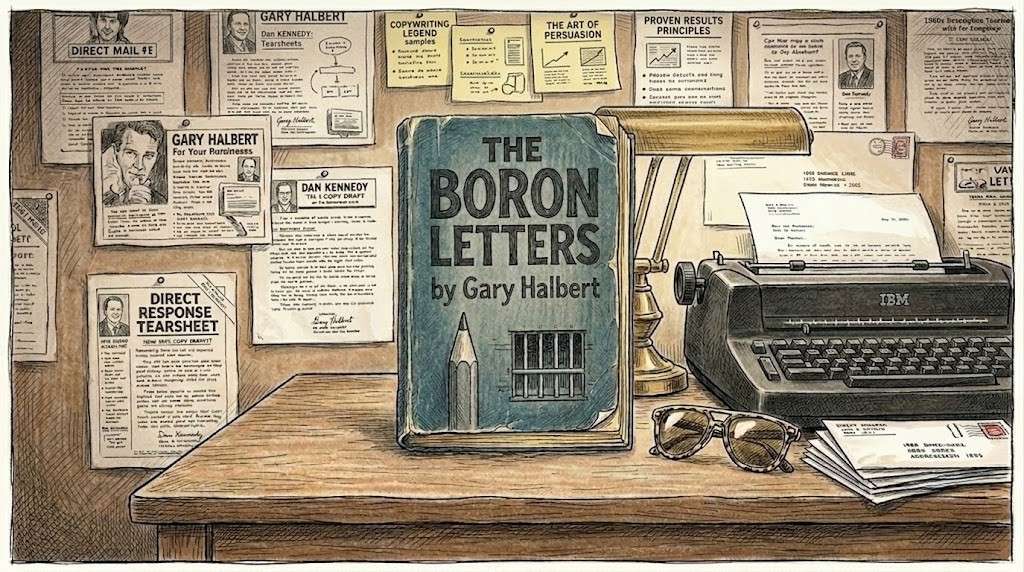
While serving his time, Halbert began writing a series of daily letters to his eldest son, Bond Halbert. He wanted to pass down his complete life philosophy, his strict health routines, and his hyper-advanced understanding of human persuasion.
Those letters were later compiled and are known globally as The Boron Letters. Today, they are maintained by his son, Bond Halbert, and are widely considered required reading for top-tier digital marketers.
The biggest, most foundational lesson I ever learned from Gary is simple: Be yourself.
Be yourself, especially in your writing. If you are going to be a certain way, show up that way consistently and own exactly who you are. Stop trying to sugarcoat things to please everybody. Halbert pushed the envelope constantly… he definitely leaned on the sensationalized side… but he did it with absolute authenticity. Because he was unapologetically himself, his readers trusted him with their lives and their wallets.
The beauty of The Boron Letters is how they are written. They aren’t dry academic lectures. They are warm, brash, direct, and written like a close friend talking to you over a cup of coffee.
Here are three core lessons pulled straight from the pages of Boron that apply directly to your current business model:
- Be a Student of Reality: Halbert constantly told his son to look at what people actually buy, not what they say they will buy. Cash tells the truth; opinions don’t.
- The Power of Clarity: He obsessed over making copy easy to read. He used short sentences, simple words, and deep line breaks… a layout style designed to create an effortless slippery slope from the headline straight to the order form.
- Keep Your Momentum: He believed that writing copy requires intense personal energy. If you are bored while writing it, your prospect will be bored while reading it.
The Halbert Principles: Writing for Immediate Response
Halbert sampled the scientific tracking principles laid out by Claude Hopkins and fused them with a raw, conversational swagger that later heavily influenced masters like Dan Kennedy.
If you want your ads, emails, and sales pages to convert cold traffic today, you need to execute these four Halbert rules.
1. The Starving Crowd (The Ultimate Market Filter)
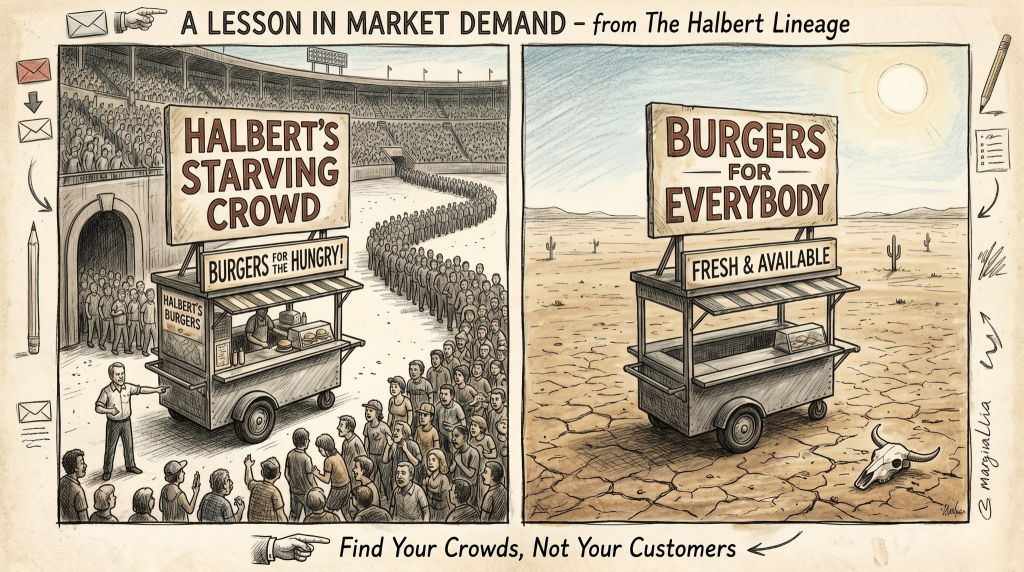
As Halbert proved with his burger stand analogy, the market always trumps the copy. If you try to sell a premium steak to a crowd of strict vegetarians, the most brilliant sales letter in the world will yield a zero percent conversion rate.
Your number one job as an entrepreneur isn’t to write words… it’s to find a group of people with a massive, unmet, agonizing problem and position your product right in front of them.
This is the exact operational framework behind choosing a “Tiny TAM.” You don’t need millions of people in a giant, expensive, competitive market. You just need a tightly focused, hyper-responsive crowd that is already starving for a resolution. When you find that crowd, you can easily create an irresistible offer that completely commands their attention.
2. The “A-Pile vs. B-Pile” Mail Framework
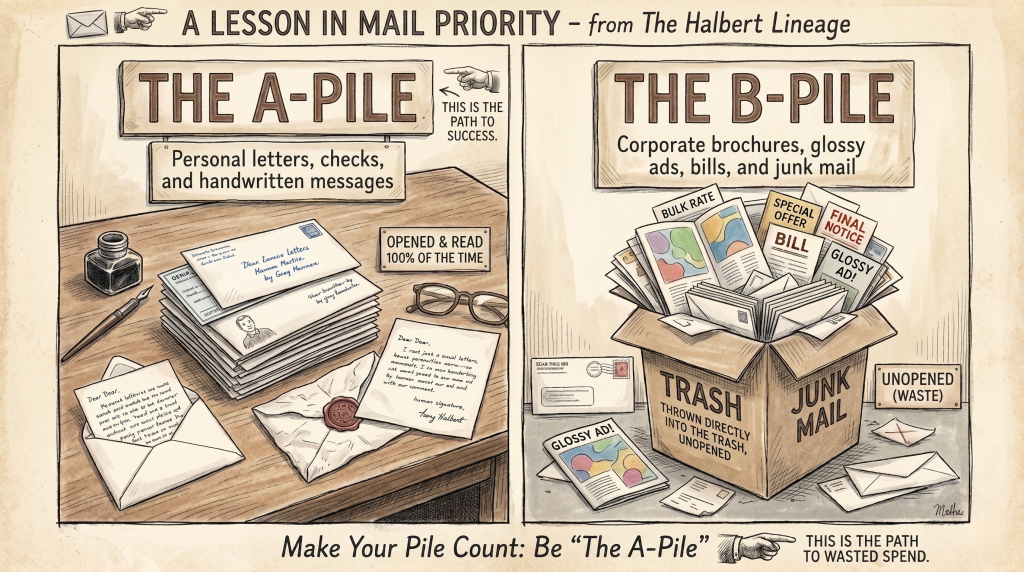
Halbert taught his students to look at how people sort their daily mail. When people stand over the wastebasket, they sort envelopes into two distinct piles:
- The A-Pile: Personal letters, checks, and messages written specifically to them by another human being. This pile gets opened and read 100% of the time.
- The B-Pile: Corporate brochures, glossy advertisements, bills, and junk mail. This pile gets thrown directly into the trash without being opened.
In the digital world, your emails, social media ads, and landing pages face the exact same filter. If your ad looks like a polished corporate commercial, people scroll right past it. If your email reads like a broadcast corporate announcement, it gets deleted. To win, your marketing must look like a personal, one-to-one communication from a trusted peer.
3. Write Like You Talk
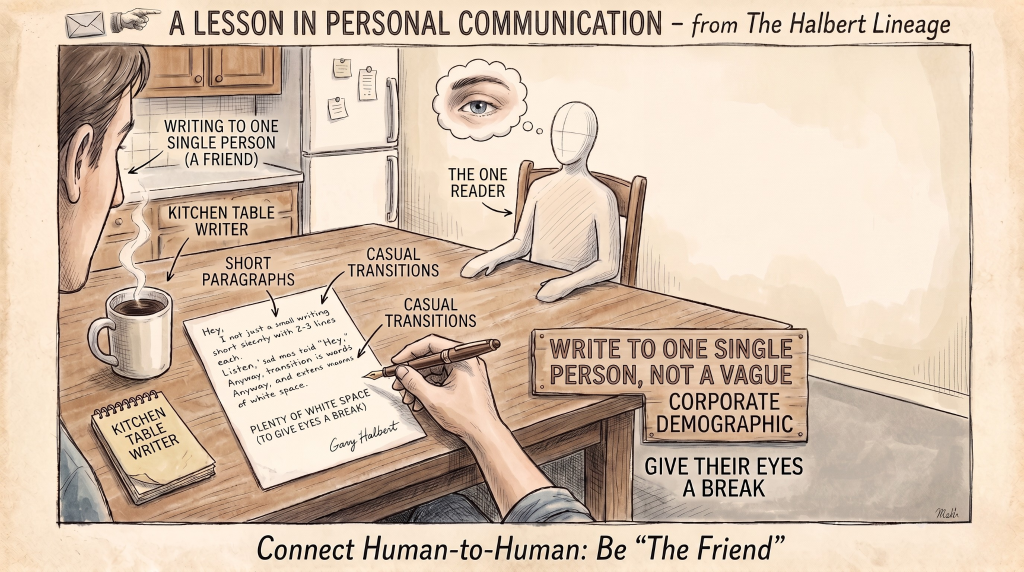
Halbert’s signature style was highly casual and intensely personal. He championed the rule of writing to one single person, rather than a vague corporate demographic.
He didn’t write to a “target persona array”… he wrote like he was sitting across a kitchen table from a friend. That means using short paragraphs, casual transitions, and plenty of white space to give the reader’s eyes a break.
4. Test with Cold Hard Cash

Halbert had a healthy contempt for theoretical marketing experts and focus groups. He believed that the only test that matters is when someone reaches into their pocket, pulls out a credit card, and hands you their hard-earned money. He advised testing ideas on a small scale with your own budget before ever rolling out a massive budget or betting your business on a hunch.
What Gary Halbert Teaches Us Today
Gary Halbert was an undisputed genius of persuasion, but his chaotic financial life holds the most critical lesson of all for modern digital operators.
Halbert made millions… and lost millions. He was a master of identifying demand and writing the copy to capture it, but he did not always focus on building stable containers. He lived campaign-to-campaign, launch-to-launch, riding the massive waves of his hits and feeling the deep valleys of his misses.
If you only focus on writing great copy for one-off promotions or working as a freelance technician for clients, you are missing out on the power of info-marketing for copywriters to build actual equity.
The goal is to take Halbert’s starving-crowd instinct and map it directly onto an owned asset. When you combine the ability to spot unserved demand with an owned product, a recurring membership structure, or a clean digital funnel, you stop riding the financial rollercoaster.
You use direct response to fill the container… but the container is what holds the wealth over the long haul.
The starving crowd is the entire game. My book hands you the modern, systematic playbook to locate that exact crowd without spending thousands of dollars on broken marketing tests.
If you want to pull Halbert’s timeless demand-finding instinct into the digital landscape, structure an offer that converts cold traffic on auto-pilot, and build an asset that scales, go grab a copy of Stop Selling to Everybody for $29 today. It’s your step-by-step map to finding your sandbox, owning the asset, and dominating your niche.
Frequently Asked Questions
Who was Gary Halbert?
Gary Halbert was a legendary direct response copywriter and author widely known as the “Prince of Print.” He became famous for creating some of the most profitable direct mail campaigns in history, including the famous Coat of Arms letter, and for publishing The Gary Halbert Letter, which educated an entire generation of top-tier performance marketers.
What is The Boron Letters about?
The Boron Letters are a series of educational letters written by Gary Halbert to his son Bond from a federal prison camp in Boron, California. The letters outline a masterclass in copywriting mechanics, consumer mindset, physical health, and direct response business strategy.
What was Gary Halbert’s most famous sales letter?
His most famous piece was the “Coat of Arms” sales letter, which offered a personalized family heritage report. It was mailed by many accounts hundreds of millions of times over several decades, making it one of the most widely distributed and consistently profitable direct response letters ever written.
What is the “starving crowd” concept?
The “starving crowd” is Halbert’s primary marketing rule, which states that the single most important advantage a business can have is a market of people who already possess a desperate, urgent need for a solution. It proves that market demand is vastly more critical to success than product features or creative copy.
Are the Gary Halbert letters still worth reading?
Absolutely. Although the delivery mechanisms have transitioned from physical print and direct mail envelopes to digital landers, paid social campaigns, and email broadcasts, the timeless human psychology and copywriting formulas Halbert pioneered remain the gold standard for conversion optimization.