Most people start creating a client avatar by writing fiction.
They sit down with a blank Google Doc and dream up “Marketing Mary.” She is 45 years old. She drives a Volvo. She likes yoga on Tuesdays and drinks Pinot Grigio on Fridays.
That is cute. But it is useless.
Knowing she likes yoga doesn’t help you sell her a $5,000 copywriting package. Knowing she drives a Volvo doesn’t tell you if she has the budget to pay your retainer.
This is the “Marketing Mary” trap. And it is the reason so many talented copywriters, consultants, and coaches stay broke.
You don’t need a fictional character. You need a Perfect Buyer Profile.
What Is a Client Avatar? (And Why Most Get It Wrong)
A client avatar (also called an ideal client avatar) is a clear, specific profile of the exact buyer most likely to purchase your offer, based on pain, purchasing power, and intent.
It is not demographics. It is not hobbies.
A real client avatar answers three questions:
- Do they have the money?
- Do they have the pain?
- Do they want to solve it now?
If your avatar doesn’t qualify buyers on those three points, it is just busywork.
Why Most Client Avatar Templates Fail
I see this every day. Smart people with real skills who can’t get traction. It almost always comes down to two specific mistakes.
Mistake #1: You Are Targeting Broke People
You cannot get blood from a stone.
No matter how much they want your help, and no matter how life-changing your service might be… if they don’t have the money, they don’t have the money.
A lot of copywriters try to save everyone. They target “struggling small business owners.” The problem? Struggling businesses don’t have marketing budgets. They are trying to make payroll.
When you are creating a client avatar, the first question shouldn’t be “What is their favorite color?” It should be: “Can this person actually afford to pay me?”
Mistake #2: You Are Trying To Save Everyone
I know the feeling. You have range. You want to help the dentists, and the real estate agents, and the gym owners.
So you write generic copy that speaks to everyone. And because you speak to everyone, you speak to no one.
If you chase two rabbits, you catch neither.
Trust me, I lived this. I built a 7-figure ad agency, but I struggled for 4 or 5 years before it clicked. I was jumping from niche to niche. I tried local businesses (too broad, I tried real estate agents) no cash flow.
I was grinding.
Then, I stopped guessing. I looked at the data. Who could I get the biggest result for? Who already had the money to spend?
I went all-in on e-commerce businesses. Specifically, ones that already had momentum.
The result? In three years, we generated over $1,000,000 in online sales for ourselves and over $62 million for our clients. We spent $10 million on Facebook and Google ads.
These days, I teach copywriters to use the same principle to build their own info marketing business… pick the buyer who already has the money and the pain, and the rest takes care of itself.
I don’t say that to brag. I say it to prove a point:
Once you find your Perfect Buyer, selling becomes easy.
Client Avatar Example: Bad Avatar vs Buying Avatar (No Tool Required)
Let’s make this concrete. If you are doing this manually, here is the difference between a “Bad Avatar” and a “Buying Avatar.”
The Bad Avatar: “Small business owners who want more leads.” (This is not a buyer. This is a crowd.)
The Buying Avatar: “A info marketer doing $250K–$1M per year who already runs ads, hates discovery calls, and is frustrated that traffic isn’t turning into booked calls… even though they’re spending $5K+ per month.”
Now we know:
- They already spend money.
- They already believe in marketing.
- They already feel pain.
That person doesn’t need convincing. They need clarity.
The Better Way: Using The Perfect Buyer Tool (FREE)
You can do this manually through interviews, surveys, and years of trial and error. Or, you can shortcut the process.
We built the Perfect Buyer Tool to generate a data-backed ideal client avatar in under 60 seconds using live market psychology.
This FREE tool shows you exactly who to pitch, what to say, and how to close them fast.
And it was built from $100M In direct response sales experience. (Grab it here)
Here is how to use it step-by-step.
Step 1: Define Your Offer & Market
Keep it simple. Just tell the tool what you sell and who you think you sell it to.
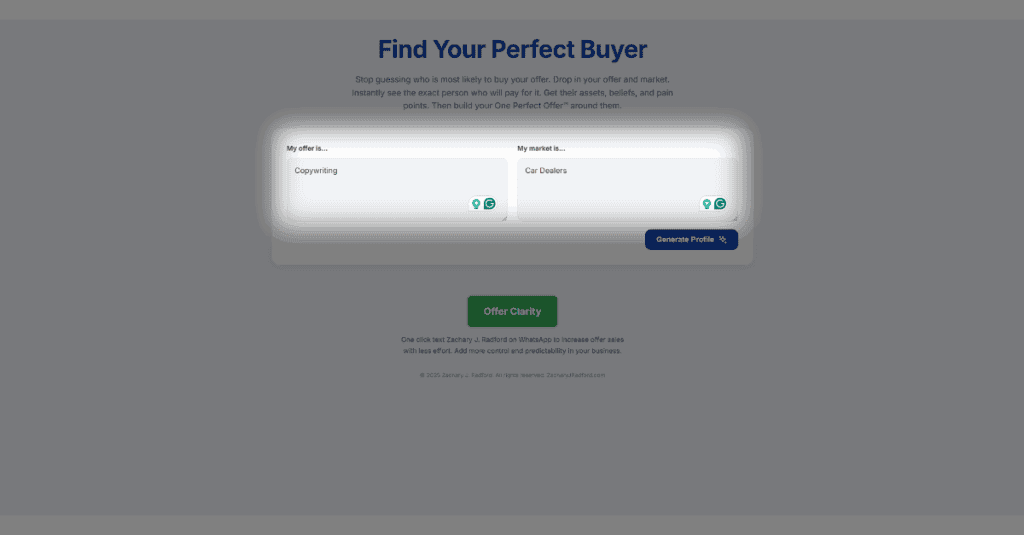
Complexity kills execution. Just enter your two variables.
Step 2: The Click
Hit the “Generate Profile” button.
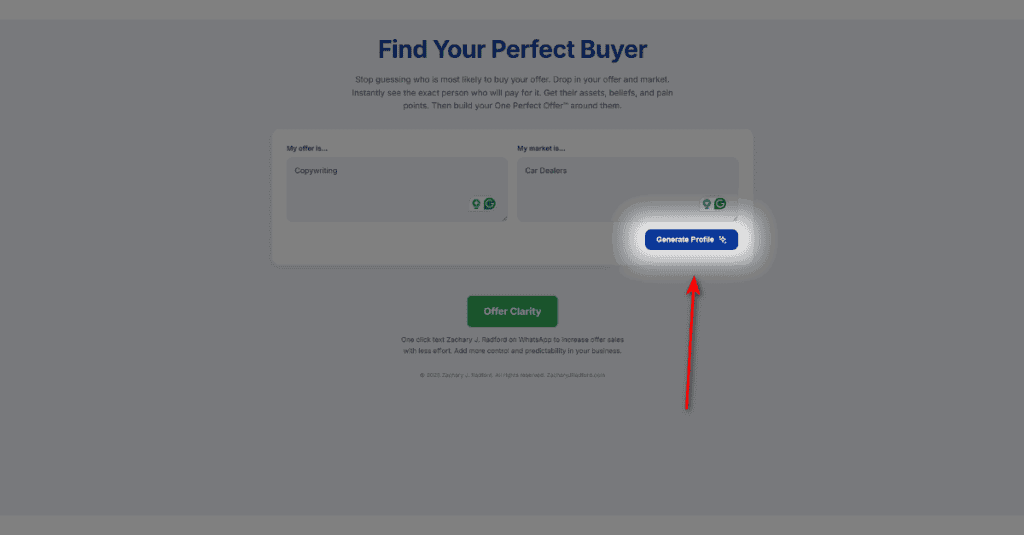
The AI isn’t just searching Wikipedia. It is analyzing the psychological triggers, market sophistication, and hidden pain points of that specific demographic.
Step 3: The “Magic” Reveal
In seconds, you get a comprehensive deep dive. No brainstorming. No writer’s block. Just raw, usable data.
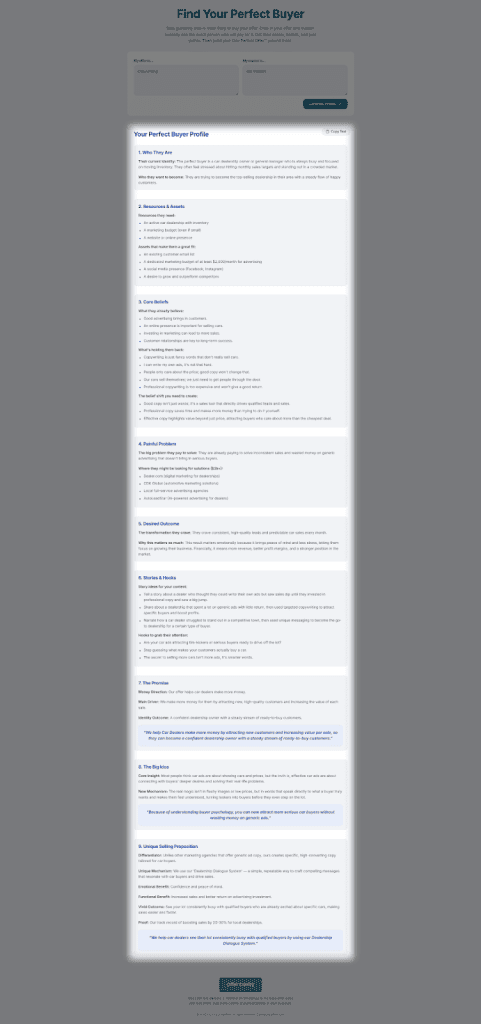
The 9 Pillars of a Perfect Buyer Profile
The tool gives you 9 specific outputs. These aren’t random. They are based on 100 years (And billions) of direct response science.
Here is how I read them… And how you should too.
We are going to use a real-world example of targeting Car Dealers.
1. Who They Are (Snapshot vs. The Dream)
Eugene Schwartz, author of Breakthrough Advertising, taught us that you cannot create desire; you can only channel it. You have to understand the role your prospect is dying to play.
Most templates just look at who the person is today. That’s fine, but it’s incomplete. You need to look at who they are trying to become.
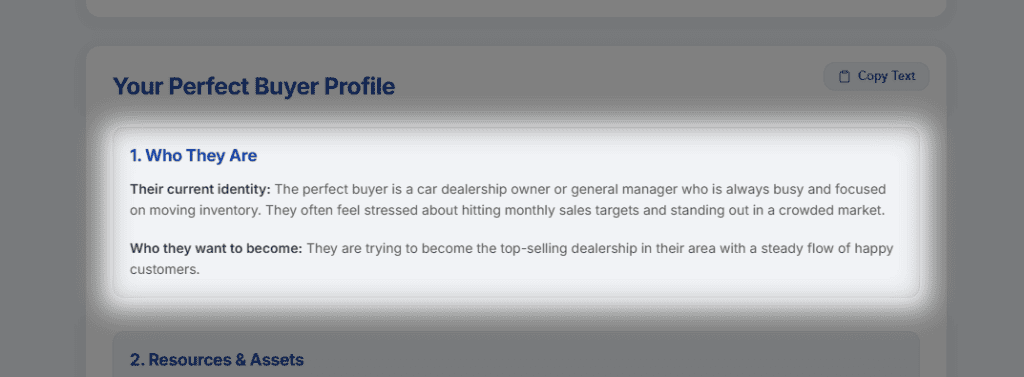
The Tool Output:
- Snapshot: “The perfect buyer is a car dealership owner or general manager who is always busy and focused on moving inventory.”
- Becoming: “They are trying to become the top-selling dealership in the area with a steady flow of happy customers.”
If you just target the “stressed manager,” you are selling a Band-Aid.
But if you target the “Future Top-Selling Dealer,” you are helping them fulfill their identity.
2. Resources & Assets (The Qualifier)
This is pure Gary Halbert. When asked what advantage he would want in a burger war, he didn’t say “better meat” or “lower prices.” He said, “I want a starving crowd.”
This section determines if your crowd has the money to buy the burger.
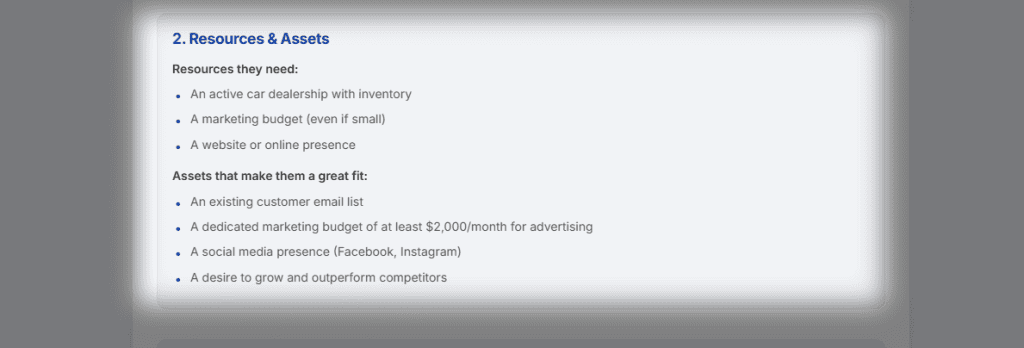
The Tool Output:
- Required Resources: “An active car dealership with inventory” and “A marketing budget (even if small).”
- Prime Assets: “An existing customer email list” and “A dedicated marketing budget of at least $2,000/month.”
This is your filter.
If you pitch a dealership that only has 3 cars on the lot, you can’t help them scale. You need a client who has the assets to win.
3. Core Beliefs (The Psychology)
Robert Collier famously said you must “enter the conversation already taking place in the customer’s mind.” You can’t fight their beliefs; you must pace and lead them.
Edward Bernays understood mass psychology better than anyone in the 20th century. He knew the buyer’s existing beliefs are the soil. Your offer is just the seed.
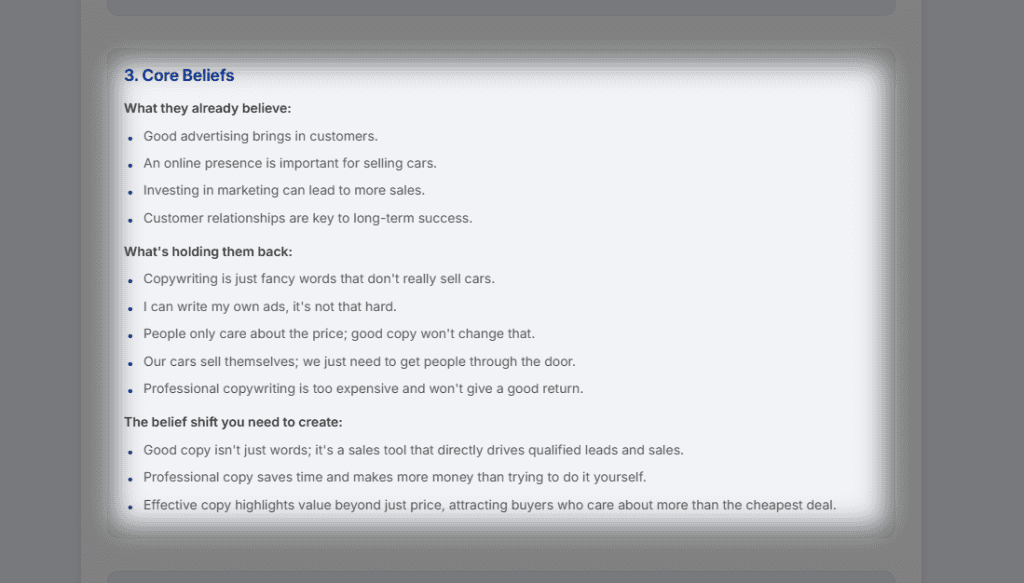
The Tool Output:
- Limiting Belief: “Copywriting is just fancy words that don’t really sell cars.”
- The Shift: “Good copy isn’t just words; it’s a sales tool that directly drives qualified leads.”
If you don’t address the belief that “copy is just words,” they will never hire you. Win that argument in their head, and the sale is easy.
4. Painful Problem (The Bleeding Neck)
This is the foundation of direct response copywriting… Problem, Agitate, Solve. You must identify the pain so clearly that the prospect feels you are reading their diary.
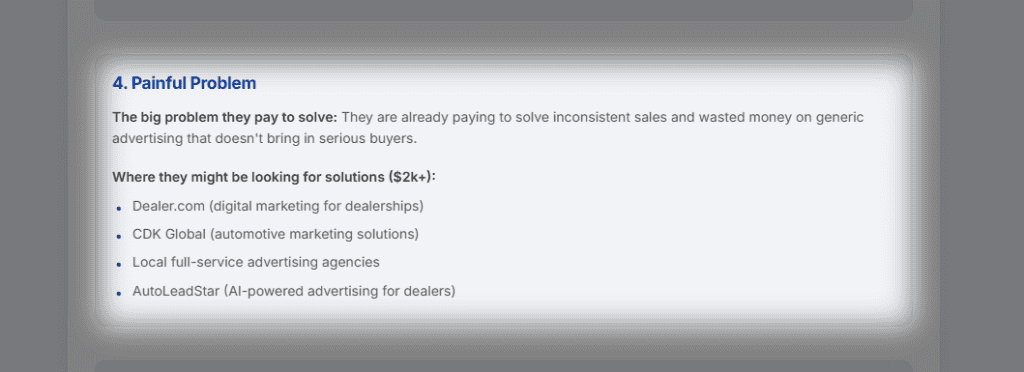
(Screenshot of Section 4: Painful Problem)
The Tool Output:
- Biggest Pain: “They are already paying to solve inconsistent sales and wasted money on generic advertising that doesn’t bring in serious buyers.”
They are spending cash on generic ads and getting zero qualified leads. That stings. That is a bleeding neck.
5. Desired Outcome (The “After” State)
Theodore Levitt famously said, “People don’t want to buy a quarter-inch drill. They want a quarter-inch hole.” Stop selling the drill (your service) and start selling the hole (the outcome).
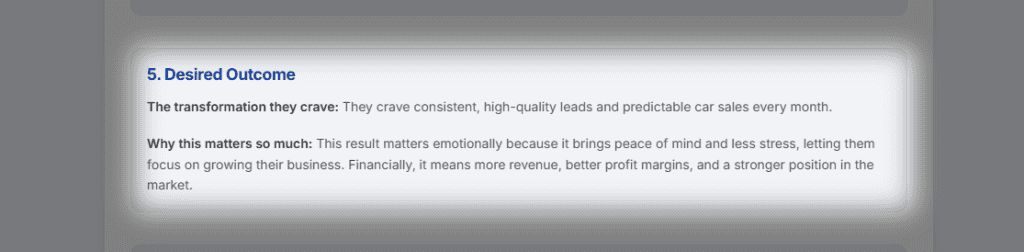
The Tool Output:
- Identity Shift: “They crave consistent, high-quality leads and predictable car sales every month.”
- Why It Matters: “It brings peace of mind and less stress.”
They want to hit their monthly quota without the end-of-month panic. Sell that feeling.
6. Stories & Hooks (Content Fuel)
John Caples, the man who wrote “They Laughed When I Sat Down At The Piano,” proved that the hook is responsible for 80% of the success of an ad.
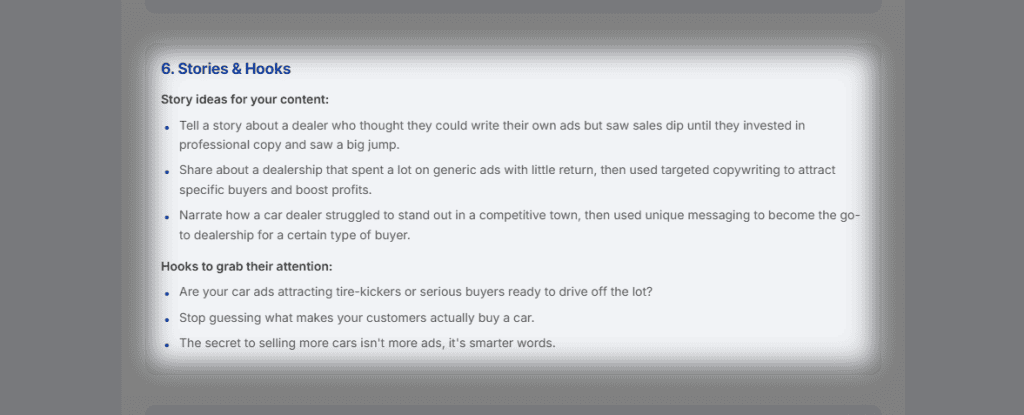
The Tool Output:
- Hook Idea: “Are your car ads attracting tire-kickers or serious buyers ready to drive off the lot?”
The tool gives you the exact script to stop the scroll. You don’t need to be creative; you just need to be relevant.
Once you’ve got the hook nailed, you’re ready to target them with Facebook ads that convert. The avatar is the ammunition. The ads are the trigger.
7. The Promise (Your Offer)
Claude Hopkins, the father of Scientific Advertising, believed in specific claims. He didn’t say “We have good beer.” He said, “We steam clean our bottles.”
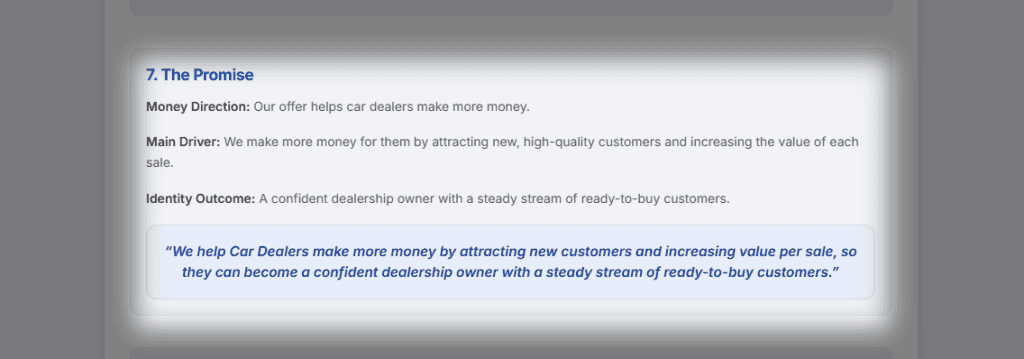
The Tool Output:
- The Promise: “We help Car Dealers make more money by attracting new customers and increasing value per sale, so they can become a confident dealership owner…”
Notice the specificity. It ties the money (increasing value) to the identity (confident owner). That is a Hopkins-level claim.
Once you’ve named the buyer this clearly, you can create an irresistible offer for them that practically sells itself. The hard work is the avatar. The offer is the easy part.
8. The Big Idea (The Angle)
David Ogilvy famously said, “Unless your advertising contains a big idea, it will pass like a ship in the night.” A Big Idea is a new mechanism or a new way of seeing an old problem.
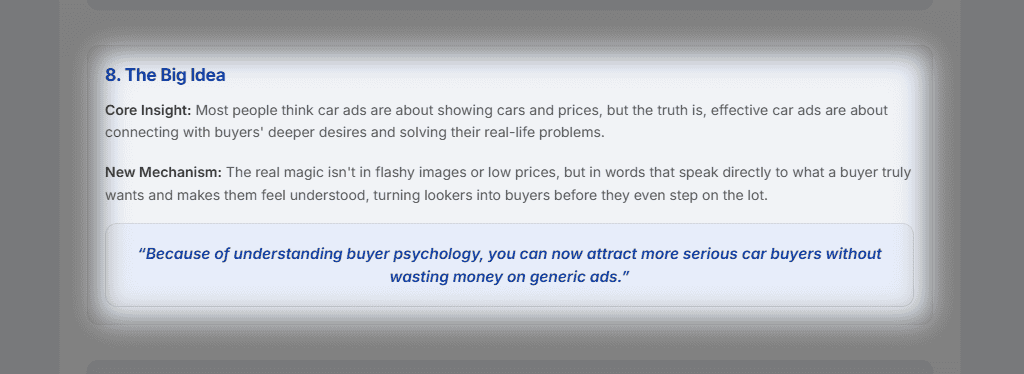
The Tool Output:
- Core Insight: “Effective car ads are about connecting with buyers’ deeper desires.”
- The Convergence: Car Sales + Psychology.
The secret isn’t showing more cars (Commodity). The secret is understanding Buyer Psychology (The Mechanism) to outsmart generic competitors.
9. The USP (Unique Selling Proposition)
In the 1940s, Rosser Reeves coined the term “Unique Selling Proposition.” He realized that to sell anything, you need a specific benefit that the competition either cannot or does not offer.
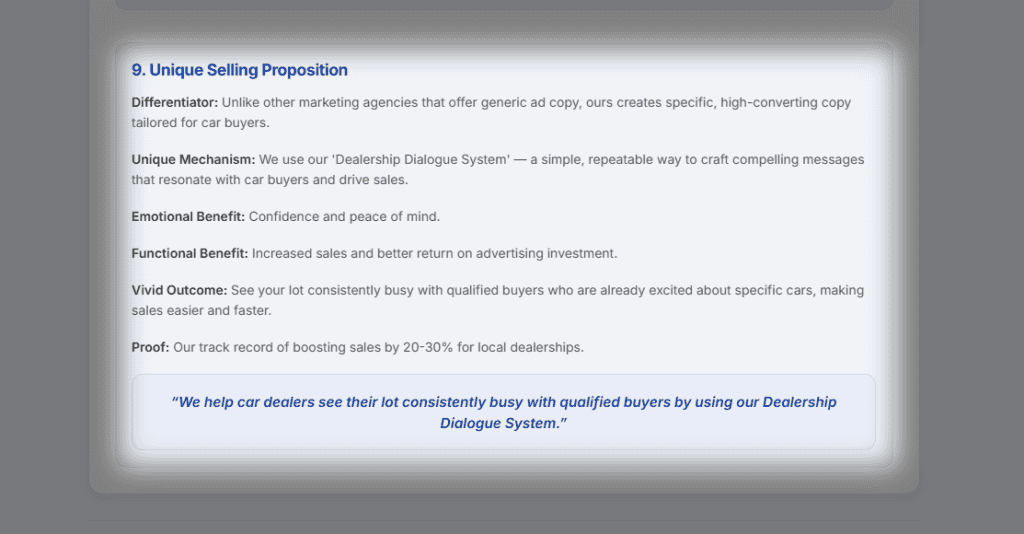
The Tool Output:
- Unique Mechanism: “We use our “Dealership Dialogue System” a simple, repeatable way to craft compelling messages.”
It’s not just “copywriting.” It’s a proprietary mechanism. It gives them a tangible reason to choose you over the agency down the street.
FAQ: Mastering Your Ideal Client Avatar
What is the difference between a target audience and a client avatar?
A target audience is a group (e.g., “Small business owners”). A client avatar is a single buyer inside that group. You market to audiences, but you write to avatars.
How do I create an ideal client avatar?
Start by identifying people who already spend money solving the problem you help with. Money spent = belief confirmed. Use a tool or conduct interviews to uncover their specific pain points.
Why is my client avatar not working?
Because it’s likely filled with fluff. If your avatar includes “eye color” or “favorite movies,” throw it out. Focus on pain, purchasing power, and urgency.
Should I target people who need my help the most?
No. The people who “need” you most often can’t afford you. Target people who want help and have the resources to pay for it.
Should I target a broad market or a narrow client avatar?
Broad markets are expensive. Narrow markets convert. Don’t target “men over 40.” Target “men over 40 going through a divorce who want to get back in shape.”
How often should I update my client avatar?
Every time you sell. When a buyer tells you exactly why they bought, write that down. That is gold.
Conclusion: Stop Guessing. Start Closing.
You have a choice.
You can keep guessing. You can keep targeting “struggling” businesses and wondering why your invoices aren’t getting paid. You can keep filling out 20-page worksheets about your avatar’s favorite ice cream flavor.
Or, you can get serious.
You can find the Perfect Buyer who has the money, the pain, and the desire to move now.
I built the Perfect Buyer Tool to solve this exact problem. It’s the same logic we used to build a $100M track record. And I want you to have it.
Stop Targeting Broke People. Find Your Perfect Buyer In 60 Seconds.
This FREE tool shows you exactly who to pitch, what to say, and how to close them fast. Built From $100M In Direct-Response Sales.

[Send Me My Perfect Buyer]
(No spam. Just instant access to the tool built on $100M of proven campaigns — free.)
Scott Oldford Media Mogul/Business Coach “Zach showed us how to build info businesses that actually sold to SEMrush in 2024. His offer-first method turns expertise into scalable businesses.”
Brian Kurtz A Titan Of Direct Response “Zachary Radford is one of those special people: A student of direct response at his core and willing to teach all he learns freely and without fear of competition.”
Andrew Lucas Entrepreneur “This simple system helped me hit $42K revenue months with no employee headaches, no client drama, and complete control over my schedule.”