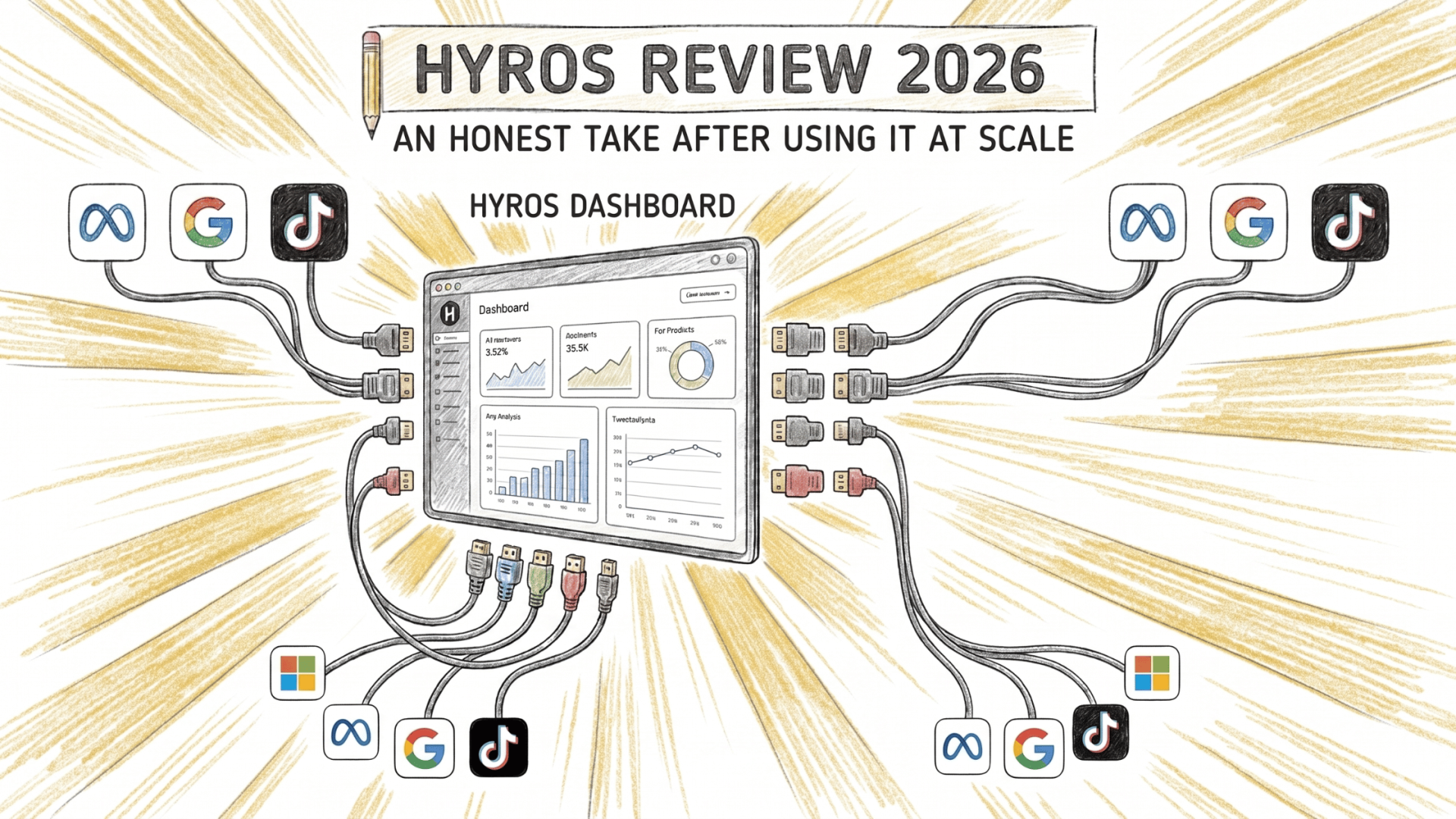

Most Hyros reviews online are written by affiliates earning commission.
That’s not this one.
I’m not affiliated with Hyros. Never have been. I used the platform on a real client at the agency back in 2022 when we were scaling to $200,000 to $300,000 a month in ad spend. We tested it, we ran it, we eventually moved off of it. So I have actual opinions about what works, what doesn’t, and where it fits in the broader attribution software landscape in 2026.
If you’re researching Hyros and trying to figure out whether the price tag is worth it, this review will save you some time. I’ll cover what it does well, where it falls short, who it’s actually right for, and four alternatives worth considering before you sign up.
Let’s get into it.
Quick verdict: Hyros is a legitimate ad attribution tool with strong white-glove service. It’s most useful for coaching, consulting, and info marketers spending $25,000+ per month on ads. For ecommerce brands, Triple Whale is generally a better fit. For under $25K/month in spend, you don’t need attribution software at all… a properly-built tracking spreadsheet (like the one I’ll share at the bottom of this post) will get you 90% of the way there for free.
Why Attribution Software Became Important In 2026
Before we get into the Hyros specifics, it helps to understand WHY everyone’s suddenly talking about attribution software.
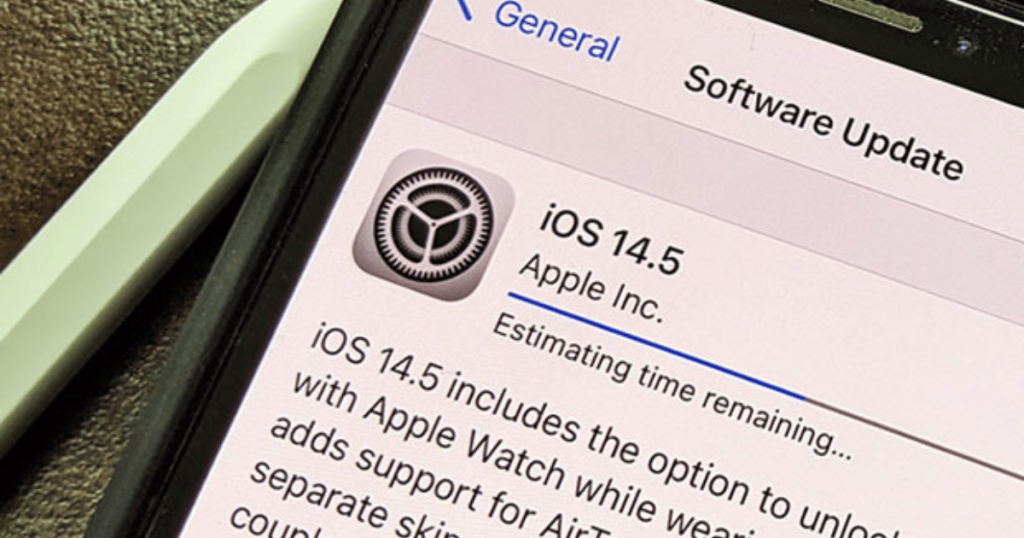
In 2021, Apple released iOS 14.5. That update gave users the option to opt out of app tracking, and roughly 84% of them did. Almost overnight, Meta (Facebook and Instagram) lost the ability to track conversions reliably. The pixel still worked, but it was missing huge chunks of data. Reported conversions dropped 50% or more across the board. Not because campaigns stopped working… because the platforms could no longer SEE what was happening.
That broke the way most marketers had been making decisions for a decade. You’d run a campaign, see terrible numbers in Meta Ads Manager, and have no idea if the campaign actually failed or if the tracking just couldn’t see the conversions.
Server-side attribution tools like Hyros stepped in to fill the gap. Instead of relying on the platform pixels, these tools track conversions on your own server using first-party data. Theoretically, they catch the conversions Meta and Google miss.
That’s the pitch. The reality is more nuanced. Which is exactly why I’m writing this review.
What Hyros Actually Is
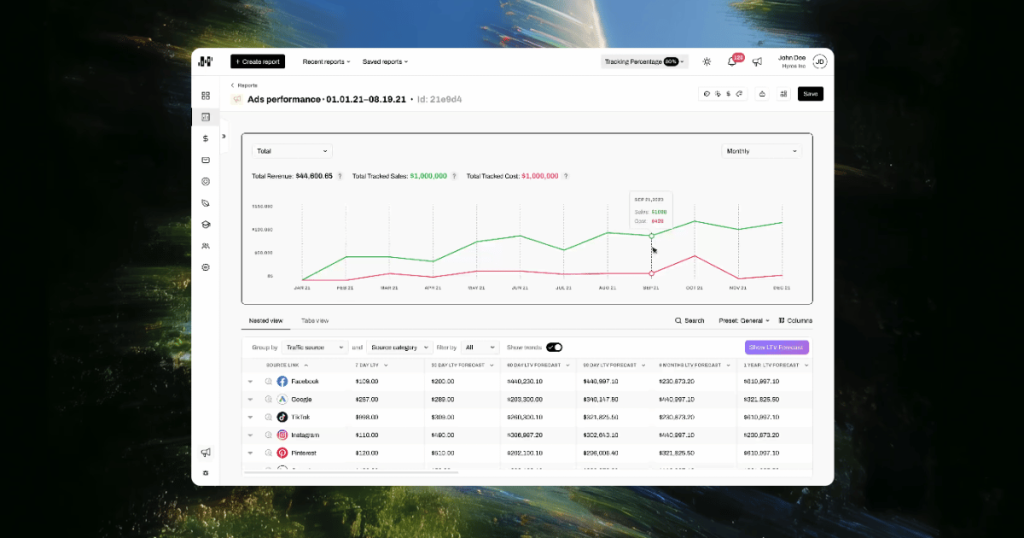
Hyros is a server-side ad attribution and tracking platform created by Alex Becker. It’s marketed as “Hyper-Accurate Ads Tracking Software” and promises to recover conversions that Meta, Google, and other platforms miss due to iOS restrictions and browser-level tracking limitations.
The core idea… when someone clicks an ad, Hyros captures that click data on its own servers. When that person eventually converts, Hyros connects the conversion back to the original ad source, even if it happened weeks or months later, even if the customer changed devices, even if the platform pixel missed it entirely.
In theory, you get a more complete picture of what’s actually driving sales.
In practice, my experience was more mixed.
My Personal Experience With Hyros
I first used Hyros back in 2022 when we were running our media buying agency. We had an ecommerce client scaling to about $200,000 to $300,000 a month in ad spend. This was right when Apple’s iOS 14.5 was wreaking havoc on Meta’s tracking. There was a lot of uncertainty about what was working and what wasn’t. Meta was rolling out CAPI (the Conversions API) to try to plug the gaps. Everyone was scrambling.
We brought Hyros in to try to get a clearer picture. Here’s what actually happened.
The Setup Experience
The setup was smooth. That was the first pleasant surprise.
When you sign up for Hyros, you get assigned a dedicated representative who works with you one-on-one to get the platform installed and configured. They walked us through the integration with the client’s stack. They helped us get attribution flowing. It wasn’t a self-serve nightmare.
That white-glove service is one of the genuinely strong things about Hyros, and I’ll come back to it.
What Worked
The best thing about Hyros for our agency was the human support. Having somebody to actually walk us through the setup, explain what we were seeing in the dashboard, and help us organize the data was a real differentiator. Most software at this price point gives you documentation and a Slack channel. Hyros gave us an actual person.
For the right kind of client, that’s worth real money.
What Didn’t Work
The frustrating part… it was extremely expensive for the value it actually delivered.
Don’t get me wrong, the data was BETTER than what we were seeing inside Meta. But it still wasn’t a complete picture. There were still gaps. There were still conversions we couldn’t fully attribute. There were still moments where we looked at the Hyros dashboard, looked at the Meta dashboard, looked at the actual sales data, and made our best guess about what was really driving results.
It gave us a slightly better picture. Not a complete one. And for the price tag we were paying, “slightly better” wasn’t enough.
We ended up taking the client off of Hyros and just tracking the data manually in a spreadsheet using proper naming conventions. It worked almost as well.
That should tell you something.
The Pricing Question
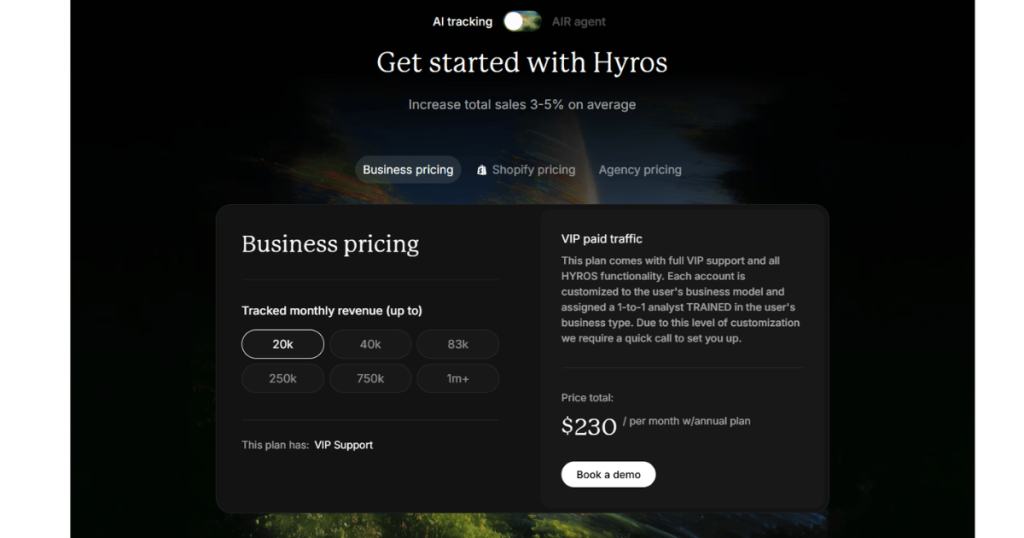
Hyros doesn’t publicly publish detailed pricing on their main page anymore (you have to book a demo to get current numbers), but based on industry reporting and what we paid in 2022…
- Organic plans: Start around $99/month for tracking organic traffic only
- Paid Traffic plans: Start around $297/month and scale up based on tracked revenue, often reaching $799-$1,500/month for serious advertisers
- Agency plans: Custom pricing, typically several thousand per month
For context… at $25,000/month in ad spend, paying $797/month for Hyros means you’re spending 3.2% of your ad budget on attribution software alone. At $100,000/month in ad spend, the percentage drops dramatically.
This is why my honest answer about Hyros depends entirely on your spend level.
Pros And Cons
Pros
- White-glove onboarding and dedicated rep makes setup smooth
- Server-side attribution catches conversions platform pixels miss
- Strong call attribution for coaching/consulting funnels
- Clean, customizable dashboards
- Multi-touch attribution gives you more granular insight than last-click
- Cross-device tracking works as advertised most of the time
- Genuinely useful for businesses with long sales cycles or high-ticket offers
Cons
- Expensive relative to the value for many businesses
- Tracking still isn’t 100% accurate (no attribution tool is)
- Pricing isn’t transparent until you book a demo
- For ecommerce specifically, Triple Whale typically outperforms it
- Steep cost-to-benefit ratio for advertisers under $25K/month in spend
- Can create false confidence in data that’s still partially incomplete
- Better suited for info/coaching than ecom in my experience
Who Hyros Is Right For (And Who Should Skip It)
This is the question that matters most. Based on my actual experience using the tool…
Hyros makes sense if you are…
- Spending $25,000+ per month on paid ads
- In the coaching, consulting, or info marketing space
- Running funnels with phone calls as a key conversion event (this is one of Hyros’ real strengths)
- Selling high-ticket offers with longer sales cycles
- Already comfortable with attribution data and ready to act on it
Hyros is probably NOT right for you if…
- You’re spending under $25,000 per month on ads (the cost-to-value ratio doesn’t work)
- You’re running a pure ecommerce brand (Triple Whale is generally better, more on this below)
- You’re a beginner still learning paid traffic basics
- You’re looking for 100% accurate attribution (no tool delivers this… not Hyros, not Triple Whale, not anyone)
If you’re in that second bucket, save your money. A well-built tracking spreadsheet will get you most of the way there. I’ll share the exact one we used at the agency at the bottom of this post.
4 Hyros Alternatives Worth Considering
I’ve used or evaluated several of Hyros’ main competitors over the years. Here’s the honest breakdown.
1. Triple Whale (Best For Ecommerce)
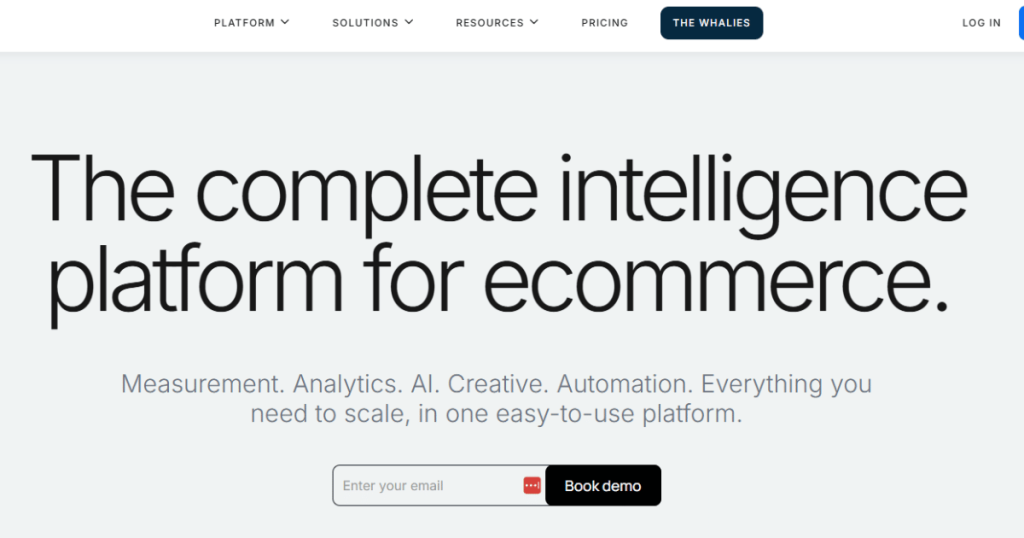
After we moved our ecommerce client off Hyros, we went to Triple Whale. It worked really, really well.
We ended up scaling that ecommerce brand to over $6 million in revenue using Triple Whale as the attribution layer. We used it on another knife brand and scaled that one to about $1.7 million. The tool fit the ecommerce model in a way Hyros didn’t.
Triple Whale is built specifically for Shopify-based ecommerce businesses. It pulls in data from Meta, Google, TikTok, your store, your CRM, your email platform, and gives you a unified dashboard built around the metrics ecom operators actually care about. AOV, ROAS, blended CAC, contribution margin, by-product breakdowns. The interface speaks ecom.
If you’re running a Shopify store and you’re choosing between Hyros and Triple Whale, my honest recommendation is Triple Whale. Every time.
Check out Triple Whale here.
2. Wicked Reports (Strong Generalist Option)
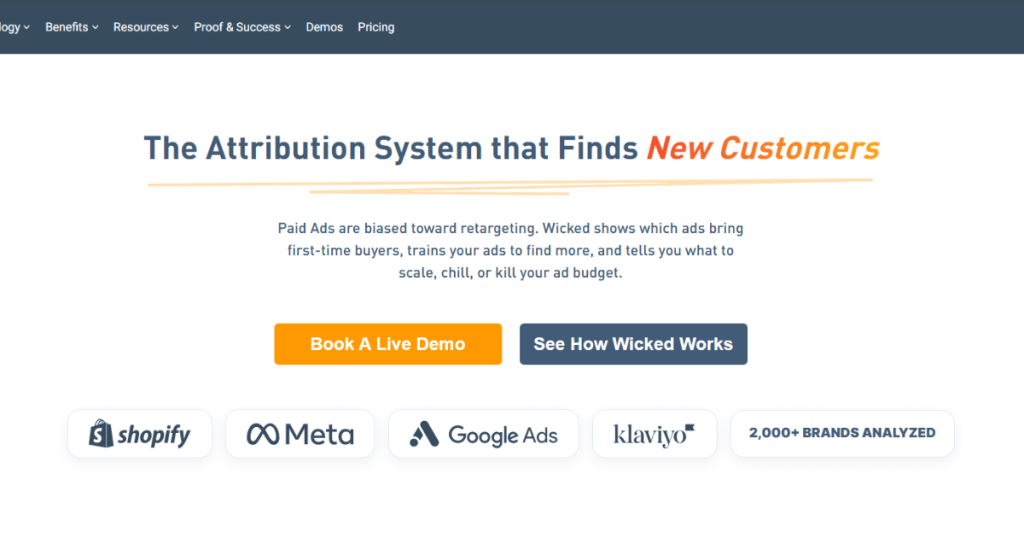
Wicked Reports was the second-closest competitor to what Hyros offered for our agency. It does multi-touch attribution across most major ad platforms and integrates with a wide range of CRMs and ecommerce platforms.
It’s a solid, well-established option. We didn’t end up using it long-term, but the demos were strong and the platform has real users running real money through it.
If Hyros and Triple Whale both feel wrong for your business, Wicked Reports is worth a look.
Check out Wicked Reports here.
3. RedTrack (Great For Affiliate And Performance Marketers)
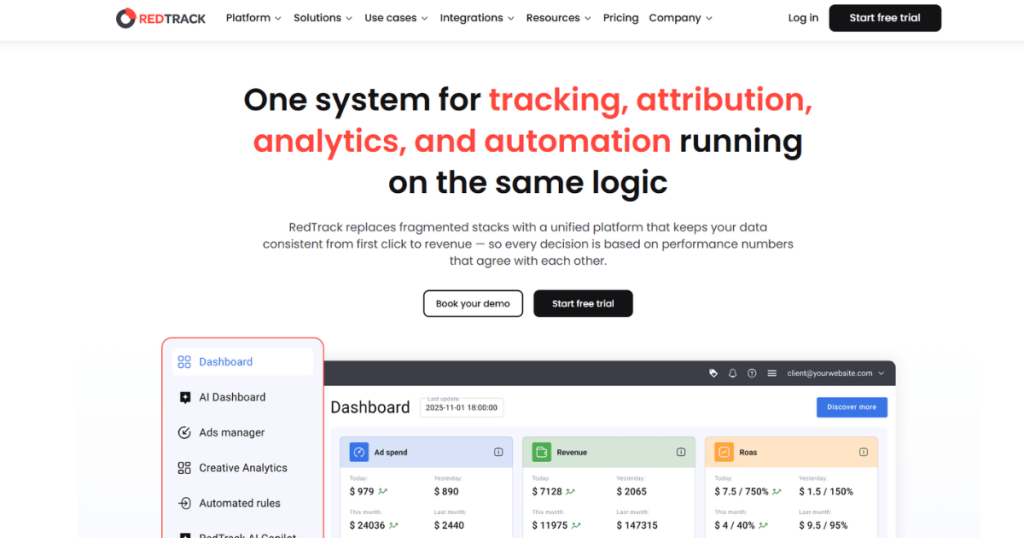
We met with the RedTrack team and the platform looked really good. We didn’t end up using it for our clients, but the people building it clearly understand performance marketing at a deep level.
RedTrack tends to attract affiliate marketers, performance media buyers, and businesses with complex multi-channel funnels. The pricing is generally more accessible than Hyros, and the feature set is genuinely competitive.
Worth evaluating if you’re in performance marketing or running affiliate campaigns.
Check out RedTrack here.
4. ClickMagick (For Affiliate Offers)
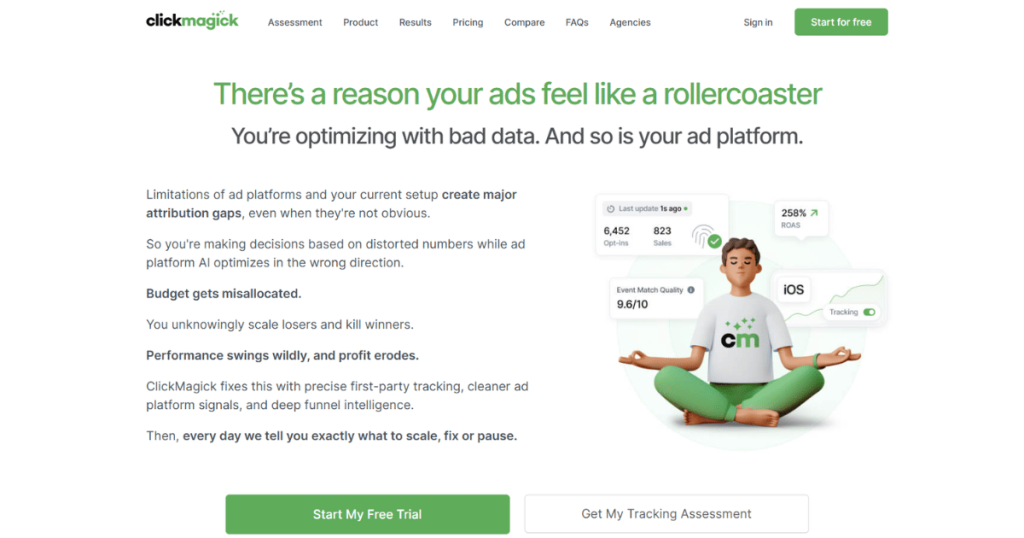
We used ClickMagick on some affiliate offers, though never for anything major. It’s a different category of tool than Hyros… more of a link tracker and click-management platform than a full attribution suite.
If you’re running affiliate campaigns and you need solid link tracking with some attribution capabilities layered on top, ClickMagick earns its place. It’s not trying to compete with Hyros on enterprise-level attribution… it’s a focused tool that does its specific job well.
Check out ClickMagick here.
How I’d Sequence The Tools
I’m not going to tell you one tool is universally better than another, because the right answer genuinely depends on your business. But here’s a rough decision framework based on my own experience…
- Coaching, consulting, info marketing at $25K+/month spend: Hyros (or Wicked Reports as alternative)
- Ecommerce/Shopify: Triple Whale
- Performance marketing or complex multi-channel: RedTrack
- Affiliate offers: ClickMagick
- Under $25K/month in spend: None of them. Use a spreadsheet (see below).
What Most Hyros Reviews Get Wrong
Here’s the truth nobody on those affiliate review sites will tell you…
Tracking is wrong most of the time. Facebook’s data is atrocious. Google’s can be spotty too. Hyros’ data is better, but it’s not perfect either. NO attribution tool gives you 100% accurate tracking. Anyone who tells you otherwise is selling you something.
At the end of the day, the most reliable measurement is the one that’s been working since direct response was invented… money spent versus money in. Look at what you’re putting into ads. Look at what’s coming out as actual cash. Use proper naming conventions in your campaigns so you can manually trace which ads, audiences, and creatives are pulling weight. Test in a way that lets you isolate variables.
You can track manually. In fact, I found tracking manually to be one of the best ways to do it during the years we ran our agency.
That’s why I built the Profitable Ads OS… a Google spreadsheet system we used to track every dollar in and every dollar out across our client campaigns. It’s not as fancy as Hyros. It doesn’t have AI. It doesn’t have a dashboard with thirty different filters. But it works, and it’s free.
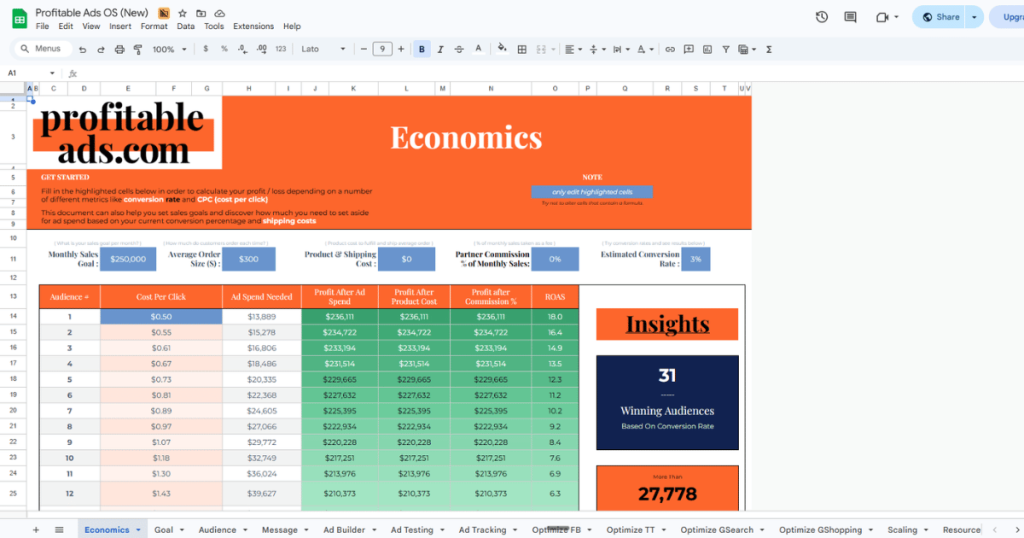
You can grab a copy of the Profitable Ads OS here.
Click the link, hit File → Make a Copy, and it’s yours. Use it as your starting point for tracking, whether or not you ever invest in attribution software.
The Final Verdict
Is Hyros worth the investment?
It depends on what industry you’re in and how much money you’re spending.
If you’re in the coaching, consulting, or info marketing space and you’re spending $25,000+ per month on ads, AND you’re running funnels with phone calls or longer sales cycles… Hyros earns its place. The white-glove service alone is worth something. The data is better than what you’ll see inside Meta or Google. And for the right business, the price tag pays for itself.
If you’re running ecommerce, look at Triple Whale instead. That’s where we ended up, and we scaled two brands to seven figures using it.
If you’re spending less than $25,000/month on ads, skip the attribution software entirely. Build your tracking system in a spreadsheet, use proper naming conventions, and focus your money on better creative and a better offer instead. The Profitable Ads OS link above will save you the cost of Hyros for at least a year.
Attribution software is a real category solving a real problem. But it’s not magic, and the right answer depends on your business… not on whatever the affiliate review sites are pushing this week.
What No Attribution Tool Will Solve
You can have the best attribution software in the world. If your offer doesn’t convert, none of it matters.
The thing every attribution tool assumes you’ve already figured out is the offer underneath. Hyros doesn’t fix bad creative. Triple Whale doesn’t fix a broken funnel. Wicked Reports won’t save a product nobody wants.
Driving traffic is the easy part. Converting traffic is where most marketers burn through their budgets wondering why their ROAS is broken.
If you’re at the stage where you’re evaluating attribution software, it usually means you’re already past the basics. You’re spending real money. You’re running real campaigns. The question isn’t whether you can run ads anymore… it’s whether the offer underneath is built to scale.
That’s the part most marketers skip. They keep buying tools when what they actually need is a better offer.
If you want a deeper dive into what makes a paid traffic offer actually convert in 2026, I broke it down in my Facebook Ads 2026 guide and in my piece on how to create an irresistible offer that converts cold traffic.
I also wrote a free book called Sales Energy that walks through the offer-first framework I’ve used to scale info businesses past seven figures. It’s the playbook I wish I’d had when I was scaling that first ecommerce client. Grab a copy. It’s free.
P.S. The single biggest improvement you can make to your attribution data isn’t switching tools. It’s writing better ads that pull harder traffic. A great ad with a great offer makes attribution easy because the conversion rate is so high you don’t NEED a fancy tool to see what’s working. A bad ad with a bad offer needs Hyros, Triple Whale, AND a prayer just to figure out what’s failing. Build the offer first. Buy the software second. That’s the order that actually works.
Frequently Asked Questions About Hyros
Is Hyros worth the price in 2026?
It depends on your business. For coaching, consulting, and info marketers spending $25,000+ per month on ads, Hyros earns its price tag through better attribution data and white-glove service. For ecommerce brands, Triple Whale is typically a better fit. For advertisers spending under $25,000 per month, the cost-to-value ratio doesn’t work and a tracking spreadsheet will deliver 90% of the value at zero cost.
How much does Hyros actually cost?
Hyros pricing varies based on tracked revenue and plan tier. Organic plans start around $99/month. Paid Traffic plans typically start around $297/month and scale up to $797-$1,500/month or higher for serious advertisers. Agency plans are custom-priced. Pricing isn’t fully transparent until you book a demo, which is one of my honest criticisms of the platform.
Is Hyros better than Triple Whale?
For ecommerce brands, Triple Whale is generally better. It’s purpose-built for Shopify-based businesses, and the dashboard speaks the language ecom operators actually care about. We moved an ecommerce client from Hyros to Triple Whale and scaled them to over $6 million in revenue. For coaching, consulting, and info marketers, Hyros tends to be a better fit because of its strong call tracking and longer-cycle attribution capabilities.
What does Hyros do that Facebook and Google don’t?
Hyros uses server-side attribution to track conversions independently from the ad platforms. Meta’s pixel and Google’s tag both lost significant tracking visibility after Apple’s iOS 14.5 update in 2021. Hyros captures click data on its own servers and connects conversions back to original ad sources even when the platform pixels miss them. The tradeoff is that Hyros’ data still isn’t 100% accurate either… it’s better than platform-only tracking, but not perfect.
Is the Hyros setup difficult?
No. The setup is one of the genuinely strong parts of the platform. When you sign up, you get a dedicated representative who works with you one-on-one to install the tracking, integrate it with your ad accounts, and get attribution flowing. The white-glove service is real and it’s a meaningful differentiator from competitors that throw documentation at you and call it onboarding.
Can I track ads without Hyros or other attribution software?
Yes. For most advertisers under $25,000/month in spend, manual tracking in a spreadsheet using proper naming conventions will deliver 80-90% of the value of attribution software at zero cost. I built the Profitable Ads OS to systematize this process when we ran our agency. It’s free to copy and use.
Who founded Hyros?
Hyros was created by Alex Becker, an experienced online marketer who built and sold multiple companies before launching the platform. He’s been involved in Hyros’ development from the start, which is part of why the tool reflects a strong understanding of paid traffic operations rather than just engineering.
What are the best Hyros alternatives in 2026?
The four strongest alternatives are Triple Whale (best for ecommerce), Wicked Reports (strong generalist option), RedTrack (great for performance marketers and affiliates), and ClickMagick (focused on link tracking and affiliate offers). The right choice depends on your business model and what you’re trying to attribute.
Does Hyros work for ecommerce?
Hyros works for ecommerce, but in my direct experience, Triple Whale is a better fit for Shopify-based businesses. Triple Whale’s dashboards, integrations, and metrics are purpose-built for ecom operations. We moved an ecommerce client from Hyros to Triple Whale and scaled to $6 million in revenue, plus another knife brand to $1.7 million using the same tool.
Is server-side attribution actually necessary in 2026?
It depends. Server-side attribution genuinely matters for advertisers who can’t get a clear picture from platform tracking alone, particularly those with longer sales cycles, high-ticket offers, or multi-touch funnels. For simple, low-ticket, fast-conversion campaigns, server-side attribution is often overkill. Money spent versus money in remains the most reliable measurement, and a good naming convention plus a tracking spreadsheet will get most advertisers most of the way there.